Abstract
1. Introduction
Object detection tells us what is present.
Segmentation tells us where it exists.
Pose estimation tells us how humans move, load, bend, fatigue, stabilize, and repeat.
This “how” is the difference between watching movement and understanding it. When joints become coordinates and posture becomes a pattern, clinics gain quantified recovery, manufacturing floors gain ergonomic enforcement, and athletes gain biomechanical clarity rather than motivational abstraction. Pose estimation transforms movement into a structured feedback substrate.
2. What Pose Estimation Measures
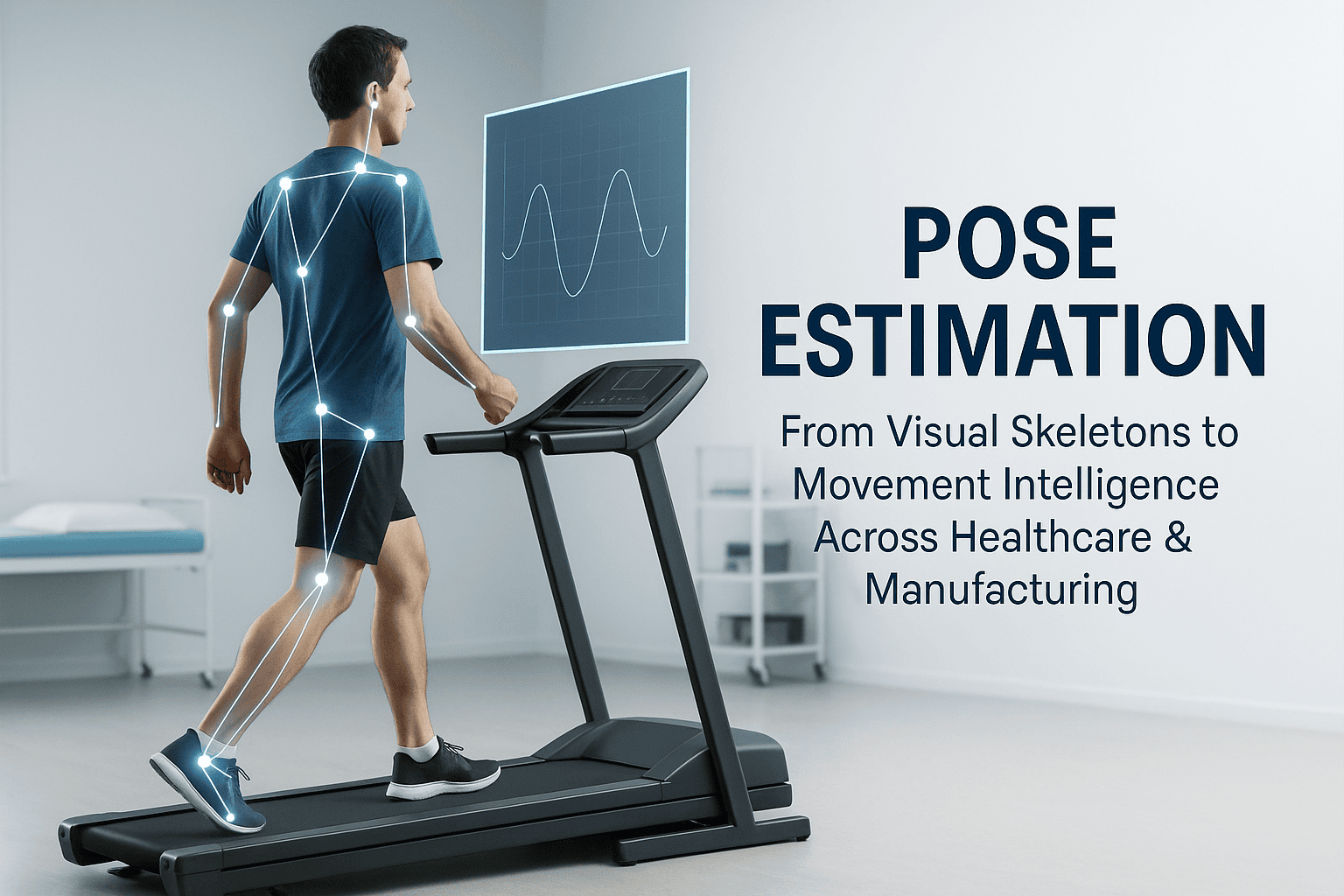
Pose estimation identifies body keypoints (shoulders, elbows, wrists, hips, knees, ankles), generates skeletal graphs, and tracks motion frames over time.
It reveals:
gait symmetry
posture bias and limb dominance
spinal compression risk
wrist-neutral vs torque-deviation curves
fatigue-triggered form collapse
co-bot proximity intention
ergonomic strain progression
Movement becomes a data layer rather than a visual presumption.
3. How Pose Systems Work
A deployment-grade pipeline includes:
Feature localization: heatmaps to detect high-probability joint points
Skeleton reconstruction: kinematic graph connections
Temporal continuity: smoothing, filtering, identity persistence
Depth/IMU fusion (optional): lift dynamics, torque compensation, 3D gait vectors
Multi-human parsing: workers, athletes, patients, therapists, co-bot zones
Pose becomes actionable when temporal memory and multimodal context are added.
4. Applications
4.1 Healthcare & Rehabilitation
Pose estimation quantifies recovery:
gait deviation maps
pre/post surgery movement comparison
tremor consistency curves
balance loss prediction
step-cycle rhythm
progress journaling without therapist subjectivity
Rehabilitation shifts from “looks better” to numerical improvement.
4.2 Sports & Performance Analytics
Performance becomes measurable instead of inspirational:
shoulder-elbow angles for bowling arcs
landing force asymmetry for jump athletes
arm recovery path in swimming
sprint stride breakdown
fatigue-induced posture collapse tracking
Technique is visualized as data, not speculation.
4.3 Manufacturing & Quality Inspection
Pose estimation acts as an ergonomic supervisor and motion-based QA instrument.
It enforces:
correct fastening torque posture
wrist neutral angles during soldering
fatigue-driven slouch or bend detection
co-bot spatial anticipation boundaries
micro-motion waste in assembly loops
| Operation | Pose-Based Value |
|---|---|
| EV battery assembly | torque posture consistency |
| PCB soldering | wrist deviation → heat drift warning |
| Medical component fit | sterile, neutral-angle enforcement |
| Co-bot line | predictive collision slow-zone triggers |
Defects drop when motion deviation is caught early instead of audited later.
5. Real-World Frictions
Pose fails when ideal lab assumptions collapse:
occluded limbs in dense assembly lines
PPE distortions
wide-angle lens distortion
multi-human identity swap
motion blur under fatigue speed
Robust setups use:
multi-camera triangulation
PAF relational cues
depth fusion
skeleton ID retention
Kalman smoothing for jitter drift
6. The Deployment Metric
Pose is considered production-ready when:
inference is real-time at edge compute
calibrations map skeletons to floor geometry
ergonomic drift is logged longitudinally
SOP deviations generate auto-alerts
workers are corrected before injuries accumulate
Pose is not detection — pose is predictive posture governance.
7. Value Proposition
Pose estimation delivers:
objective rehab scoring
ergonomic injury minimization
assembly-angle standardization
co-bot human intent prediction
defect rate reduction through form stabilization
Motion turns into telemetric proof.
8. Future Outlook
Next-phase systems will enable:
digital human twins
injury-before-injury prediction
continuous ergonomic coaching
posture-linked production throughput modeling
Movement ceases to be episodic.
It becomes a continuous compliance geometry.
9. The Evolution of Pose Technology
Pre-Deep Learning
Pictorial Structures
HOG limb models
Kinematic chains
Worked only for static, centered, single bodies.
Deep Learning Emergence
DeepPose
Convolutional Pose Machines
Hourglass Networks
Introduced contextual skeleton logic.
Bottom-Up Breakthrough
OpenPose
Part Affinity Fields
DensePose
Enabled multi-human precision and body-surface alignment.
Transformer Intelligence
HRNet
ViTPose
PoseFormer
TokenPose
Temporal grace: posture became continuity, not frame snapshots.
3D Hybrid Leap
VIBE
GraphCMR
RGB-D fusion (Azure Kinect, RealSense)
IMU + Vision biomechanics
Movement became torque, depth, and true kinematic stress tracing.
Digital Twin & Predictive Phase
SMPL-X
GHUM
NeRF human motion
Predictive fatigue analytics
Motion is not captured — motion is forecasted.
10. Conclusion
Pose estimation is the transformation of physical movement into computable precision. It elevates rehab from subjective assessment, manufacturing from repetitive injury culture, and sports training from instinctive correction to measurable biomechanics.
It stops asking “What is happening?”
and begins answering “What will happen if this posture continues?”
Pose is not a skeleton diagram.
Pose is kinetic truth in machine form.