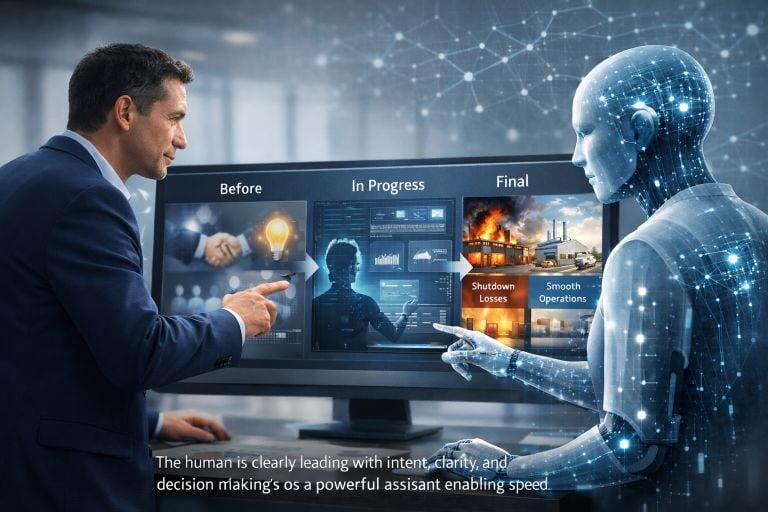
AI can create images in seconds—but turning those images into effective visuals that attract viewers, engage customers, and drive growth requires far more than speed.
Impact happens when AI-generated images are intentionally shaped into business visuals that communicate clarity, value, and trust.
Over the last two decades, working deeply in Computer Vision, AI systems, and applied industry use-cases, I have seen one consistent truth:
Today, as I work closely with business growth seekers across manufacturing, services, retail, and startups, I strongly believe that marketing is the first and most critical step in AI adoption. If your marketing visuals lack clarity, no amount of AI automation, tools, or dashboards will create growth.
The real difference is not whether you use AI for image creation.
It is how you convert AI images into purposeful visuals that serve your business goals.
How Human-in-the-Loop AI Turns Image Creation into Credible, High-Impact Business Visuals
By Dr. Raj Gupta, PhD (IIT Madras)
Leader, Miracle Eye Pvt Ltd
On a mission to help businesses grow through AI — starting with Marketing
Three Critical Mistakes I See When Businesses Use AI Images as Visuals
1. Trusting AI blindly
AI generates images fast—but it does not understand your business reality.
It can invent incorrect details, misleading symbols, or visual metaphors that look impressive but communicate the wrong message. When such images go out into the market without careful review, audiences sense the mismatch immediately.
Credibility drops silently—and recovery is expensive.
AI should support human judgment, not replace it.
2. Letting AI decide the message
Image creation is not about generating pictures.
It is about designing visuals with intent.
When AI decides the concept, emotion, or story, the output becomes generic. It may look polished, but it lacks direction. The result is visual noise—not communication.
Clarity does not come from tools.
Clarity comes from humans who understand customers, context, and consequences.
3. Using the first AI image as the final visual
Most first-draft AI outputs are predictable:
Handshakes for partnerships
Light bulbs for innovation
Abstract people standing in circles for teamwork
These visuals instantly signal “generic AI image”, not a serious business visual.
In 2026, audiences scroll past these without engagement. Familiar visuals no longer build trust—they create indifference.
The Right Way: A 6-Step Human-in-the-Loop (HITL) Workflow to Turn AI Images into Credible Visuals
This is the exact approach I follow and teach when helping businesses adopt AI responsibly in marketing.
Step 1: Start with a clear brief
Before opening any AI tool, answer three questions:
What is the purpose of this visual?
What action should the viewer take after seeing it?
Who is this really for, and what do they care about?
Clear intent gives AI direction.
Step 2: Provide context and references
Give AI your boundaries:
Brand colors and tone
Past visuals or product images
Mood or style references
AI performs best when it organizes your thinking, not when it guesses.
Step 3: Define the visual narrative
Every strong business visual follows a simple structure:
Problem vs Result
Before vs After
Chaos vs Clarity
Structure turns images into communication.
Step 4: Generate and review
Use AI to overcome the blank canvas.
But never treat the first output as the final visual. Consider it a machine-speed draft, not a deliverable.
Step 5: Iterate with precision
This is where credibility is built.
Give specific feedback such as:
“Make this more minimal”
“Replace generic elements with real product visuals”
“Show contrast instead of decoration”
Precision transforms AI from a toy into a serious assistant.
Step 6: Add human finishing touches
Refine what only humans can:
Spacing and composition
Brand tone and consistency
Meaningful visuals instead of stock-style imagery
Always ask:
Does this look like my brand—or like everyone else’s?
Demonstrating the Impact: Image vs Visual (What Changes in the Real World)
To understand why Human-in-the-Loop matters, let’s look at how the same idea performs when treated as an AI image versus a business visual.
Scenario: Promoting a Business Workshop or Product Offering
AI Image Approach (Without Human-in-the-Loop)
Generic AI-generated image (handshake, light bulb, abstract people)
Visually attractive but disconnected from the actual offer
Viewer reaction: “Looks nice, but I don’t get it”
Outcome: Low attention, low recall, weak trust
Human-in-the-Loop Visual Approach
Clear problem–result visual narrative
Real context (audience, use-case, outcome)
Minimal design focused on contrast, not decoration
Viewer reaction: “This is relevant to me”
Outcome: Higher engagement, faster understanding, stronger credibility
What Actually Changes
| Without HITL (AI Image) | With HITL (Business Visual) |
|---|---|
| Visual looks impressive | Visual communicates clearly |
| Viewer observes | Viewer understands |
| Attention fades quickly | Message stays longer |
| Aesthetic value only | Business value + intent |
The technology does not change.
The thinking around it does.
This is the difference between creating images and building visuals that drive growth.
Industry Example: Insurance Sector (Factory Fire – Industrial Insurance Persona)
Let’s take a practical example from the industrial insurance sector, where the difference between an AI-generated image and a Human-in-the-Loop visual becomes immediately visible.
Scenario
Audience: Factory owners / industrial business decision-makers
Product: Industrial fire insurance
AI Image Approach (Without Human-in-the-Loop)
AI is prompted to generate an image for “need for insurance.”
Typical AI output:
A factory building
Flames or smoke in the background
A generic shield or umbrella symbol
Firefighters or fire trucks
What this communicates:
Fire is dangerous. Insurance exists.
What it misses:
No business consequence
No downtime, no loss, no urgency
Viewer reaction:
“Fire accidents happen… noted.”
Outcome:
Awareness without action.
Human-in-the-Loop Visual Approach (With Intent and Context)
Now the same idea, guided by human thinking.
Human-defined intent:
Show the impact of not having insurance
Speak directly to an industrial decision-maker
Highlight business loss, not just physical damage
Visual narrative created:
Split visual: Before Fire vs After Fire
Before: Factory operational, workers active, machines running
After: Burnt machinery, idle workers, production halted
Subtle cues:
Missed delivery deadlines
Wage uncertainty
Long shutdown period
Minimal visual message:
“Fire lasts hours. Business loss lasts years.”
“No insurance = Business shutdown.”
Viewer reaction:
“This could happen to my factory.”
Outcome:
Relevance, urgency, trust, and intent to act.
What Changed in This Example
| AI Image | Human-in-the-Loop Visual |
|---|---|
| Shows fire | Shows business loss |
| Generic symbols | Industry-specific reality |
| Awareness only | Decision-triggering clarity |
| Looks dramatic | Feels real |
The AI tool did not change.
The human intent did.
My Key Takeaway for Business Growth Seekers
AI can generate images. Humans build visuals that drive growth.
AI gives speed.
Humans deliver clarity, relevance, and credibility.
For businesses, credibility is everything. Customers do not buy because something looks fancy. They buy because it feels clear, honest, and intentional.
Used correctly, AI becomes a powerful visual accelerator for marketing.
Used blindly, it becomes a credibility risk.
At Miracle Eye Pvt Ltd, my mission is simple:
to help businesses adopt AI the right way—with humans in control, strategy first, and marketing as the foundation.
Marketing clarity is the first step.
Growth follows.