Computer Vision Changes With the Environment.
A model that performs well in one environment may fail completely in another.
Lighting changes. Cameras change. Object scale changes. Motion changes. Failure costs change. Available training data changes.
That is why production computer vision starts with understanding the physical environment, visual complexity and operational objective before selecting a model.
Different Industries Create Different Vision Problems
| Industry | What Makes Vision Difficult | What Matters Most |
|---|---|---|
| Transportation & Mobility | Motion, weather, occlusion, long distances, changing illumination | Real-time robustness |
| Manufacturing & Industrial Automation | Tiny defects, reflective surfaces, repetitive patterns, production speed | Precision & latency |
| Retail, Commerce & Logistics | Dense objects, similar SKUs, occlusion, crowded environments | Recognition & tracking |
| Healthcare & Life Sciences | Subtle abnormalities, limited labels, imaging variation | Sensitivity & reliability |
| Agriculture & Environmental Monitoring | Seasons, sunlight, biological variation, large geographical areas | Generalization |
| Infrastructure & Smart Cities | Multi-camera systems, large scenes, changing environments | Scale & temporal intelligence |
| Media, Sports & Entertainment | Fast movement, complex actions, multiple viewpoints | Tracking & behavior |
| Security, Defense & Public Safety | Low light, distance, rare events, clutter, adverse conditions | Detection & situational awareness |
| Robotics & Autonomous Systems | Dynamic viewpoints, manipulation, occlusion, changing geometry | 3D & spatial intelligence |
We don't start with a model. We start with the visual problem.
NINE INDUSTRIES. NINE DIFFERENT VISION WORLDS.
Where We Apply Visual Intelligence
Computer vision becomes valuable when algorithms understand the realities of the environment in which they operate.
Each industry requires a different combination of perception, temporal intelligence, geometry, context and automation.
🚗 Transportation & Mobility
Understand Roads, Vehicles, People and Movement in Real Time.
Transportation vision systems operate in environments that never stop changing. Vehicles move, pedestrians appear unexpectedly, lighting varies, objects become occluded and weather changes visibility.
Visual Challenges
Fast motion • Small distant objects • Occlusion • Night conditions • Weather • Complex intersections • Camera vibration • Domain variation
Vision Intelligence
Object Detection • Semantic Segmentation • Multi-Object Tracking • Lane Detection • Depth Estimation • Optical Flow • 3D Detection • Sensor Fusion
Typical Systems
Traffic Analytics • Vehicle Tracking • Pedestrian Detection • Road Understanding • Driver Monitoring • Parking Intelligence • Incident Detection • Autonomous Perception
Engineering Priority
Low latency + temporal consistency + robust perception
Outcome
Safer mobility • Better traffic intelligence • Automated monitoring • Smarter transportation decisions
🏭 Manufacturing & Industrial Automation
See Defects, Variations and Process Errors at Production Speed.
Industrial vision frequently deals with differences that are almost invisible to the human eye while simultaneously operating under strict cycle-time requirements.
Visual Challenges
Tiny defects • Surface texture • Reflection • Repetitive patterns • High-speed motion • Product variation • Precise measurement
Vision Intelligence
Defect Detection • Anomaly Detection • Instance Segmentation • Classification • OCR • Metrology • 3D Vision • Visual Inspection
Typical Systems
Surface Inspection • Assembly Verification • Dimensional Inspection • Component Detection • Process Monitoring • Packaging Inspection • Robotic Inspection
Engineering Priority
Precision + repeatability + low false-reject rates
Outcome
Higher quality • Lower inspection effort • Reduced scrap • Improved production visibility
📦 Retail, Commerce & Logistics
Understand Products, Inventory and Movement Across Complex Operations.
Retail and logistics environments contain thousands of visually similar products moving through shelves, warehouses, conveyors and distribution networks.
Visual Challenges
Similar SKUs • Dense objects • Partial visibility • Packaging variation • Crowded environments • Changing inventory
Vision Intelligence
Product Recognition • Object Detection • OCR • Barcode Recognition • Tracking • Counting • Pose Estimation • Re-Identification
Typical Systems
Shelf Analytics • Inventory Monitoring • Package Tracking • Warehouse Automation • Product Recognition • Checkout Intelligence • Parcel Sorting
Engineering Priority
Identity + tracking + scalability
Outcome
Better inventory visibility • Reduced manual operations • Faster fulfillment • Improved operational intelligence
🩺 Healthcare & Life Sciences
Extract Meaning From Complex Biomedical Visual Data.
Healthcare vision systems often need to detect subtle patterns where visual differences can be extremely small and reliability requirements exceptionally high.
Visual Challenges
Subtle abnormalities • High-resolution data • Limited labelled datasets • Imaging variation • Class imbalance • Explainability requirements
Vision Intelligence
Medical Image Segmentation • Classification • Detection • Registration • 3D Reconstruction • Microscopy Analysis • Multimodal Models
Typical Systems
Medical Image Analysis • Lesion Segmentation • Cell Analysis • Pathology Imaging • Surgical Vision • Patient Monitoring • Laboratory Automation
Engineering Priority
Sensitivity + reliability + validation
Outcome
Faster analysis • Quantitative measurements • Research acceleration • Decision-support intelligence
🌱 Agriculture & Environmental Monitoring
Turn Fields, Crops and Landscapes Into Measurable Visual Intelligence.
Natural environments introduce enormous variation. The same crop can look dramatically different because of growth stage, geography, sunlight, season and weather.
Visual Challenges
Changing sunlight • Seasonal variation • Biological diversity • Occlusion • Large-scale imagery • Small disease patterns
Vision Intelligence
Crop Segmentation • Disease Detection • Object Detection • Multispectral Analysis • Drone Vision • 3D Reconstruction • Change Detection
Typical Systems
Crop Health Monitoring • Disease Detection • Weed Identification • Fruit Counting • Yield Estimation • Drone Mapping • Forest Monitoring • Environmental Change Detection
Engineering Priority
Generalization + scale + environmental robustness
Outcome
Earlier intervention • Better resource utilization • Improved monitoring • Data-driven agriculture
🏙️ Infrastructure & Smart Cities
Transform Large Physical Environments Into Continuously Measurable Systems.
Cities generate enormous volumes of visual information across roads, public spaces, infrastructure and transportation networks.
Visual Challenges
Large scenes • Multiple cameras • Long-duration monitoring • Environmental variation • Dense activity • Distributed infrastructure
Vision Intelligence
Object Detection • Tracking • Video Analytics • Crowd Analysis • Change Detection • Anomaly Detection • 3D Mapping • Multimodal Analytics
Typical Systems
Traffic Monitoring • Infrastructure Inspection • Crowd Analytics • Parking Intelligence • Road Condition Monitoring • Asset Inspection • Urban Analytics
Engineering Priority
Scalability + multi-camera intelligence + temporal understanding
Outcome
Better infrastructure visibility • Faster anomaly detection • Improved planning • Smarter operations
⚽ Media, Sports & Entertainment
Turn Motion and Human Performance Into Structured Intelligence.
Sports and media vision must understand fast-moving people, complex interactions and events unfolding across multiple cameras and viewpoints.
Visual Challenges
Fast motion • Occlusion • Multiple people • Camera movement • Complex actions • Rapid viewpoint changes
Vision Intelligence
Pose Estimation • Multi-Object Tracking • Action Recognition • Re-Identification • Video Understanding • Event Detection • 3D Reconstruction
Typical Systems
Player Tracking • Performance Analysis • Highlight Detection • Action Recognition • Automated Camera Systems • Content Indexing • Audience Analytics
Engineering Priority
Temporal precision + identity + behavioral understanding
Outcome
Deeper performance insights • Automated content understanding • Faster production • Richer audience experiences
🛡️ Security, Defense & Public Safety
Build Situational Awareness Across Complex and Uncertain Environments.
Security vision systems often need to identify important events that occur rarely, at distance or under difficult visual conditions.
Visual Challenges
Low illumination • Long range • Occlusion • Rare events • Crowded environments • Camera variation • Adverse weather
Vision Intelligence
Detection • Tracking • Re-Identification • Behavior Analysis • Thermal Vision • Anomaly Detection • Multi-Camera Intelligence • Sensor Fusion
Typical Systems
Perimeter Monitoring • Intrusion Detection • Crowd Monitoring • Object Tracking • Situational Awareness • Search & Rescue Support • Critical Infrastructure Monitoring
Engineering Priority
Recall + robustness + situational context
Outcome
Faster awareness • Reduced monitoring workload • Better incident understanding • Improved response intelligence
🤖 Robotics & Autonomous Systems
Give Machines the Spatial Intelligence to Perceive and Interact With the Physical World.
Robots need more than object recognition. They must understand where objects are, how they are oriented, what surrounds them and how the environment changes as the robot moves.
Visual Challenges
Changing viewpoints • Occlusion • Object manipulation • Dynamic environments • Depth ambiguity • Real-time constraints
Vision Intelligence
6D Pose Estimation • Depth Estimation • 3D Detection • Visual SLAM • Point Clouds • Segmentation • Grasp Perception • Sensor Fusion
Typical Systems
Robot Navigation • Bin Picking • Manipulation • Autonomous Inspection • Warehouse Robotics • Drone Perception • Human-Robot Interaction
Engineering Priority
Geometry + localization + real-time spatial understanding
Outcome
Better navigation • Reliable manipulation • Greater autonomy • Safer human-machine interaction
Different Problems Require Different Vision Intelligence.
The importance of each computer vision capability changes dramatically with the environment.
| Industry | Detection | Segmentation | Tracking | Video AI | 3D / Spatial | Anomaly | Multimodal |
|---|---|---|---|---|---|---|---|
| Manufacturing | ●●● | ●●● | ●● | ●● | ●●● | ●●● | ●● |
| Transportation | ●●● | ●●● | ●●● | ●●● | ●●● | ●● | ●●● |
| Retail / Logistics | ●●● | ●● | ●●● | ●●● | ●● | ●● | ●●● |
| Healthcare | ●● | ●●● | ● | ●● | ●●● | ●●● | ●●● |
| Agriculture | ●●● | ●●● | ●● | ●● | ●●● | ●●● | ●●● |
| Smart Cities | ●●● | ●●● | ●●● | ●●● | ●●● | ●●● | ●●● |
| Media / Sports | ●●● | ●● | ●●● | ●●● | ●●● | ● | ●●● |
| Security | ●●● | ●● | ●●● | ●●● | ●●● | ●●● | ●●● |
| Robotics | ●●● | ●●● | ●●● | ●●● | ●●● | ●● | ●●● |
The industry tells us where to look. The problem tells us which intelligence to build.
From Industry Problem to Vision Architecture
This is one of the most important sections of the page because it shows prospects how Visual Grab approaches an engineering problem.
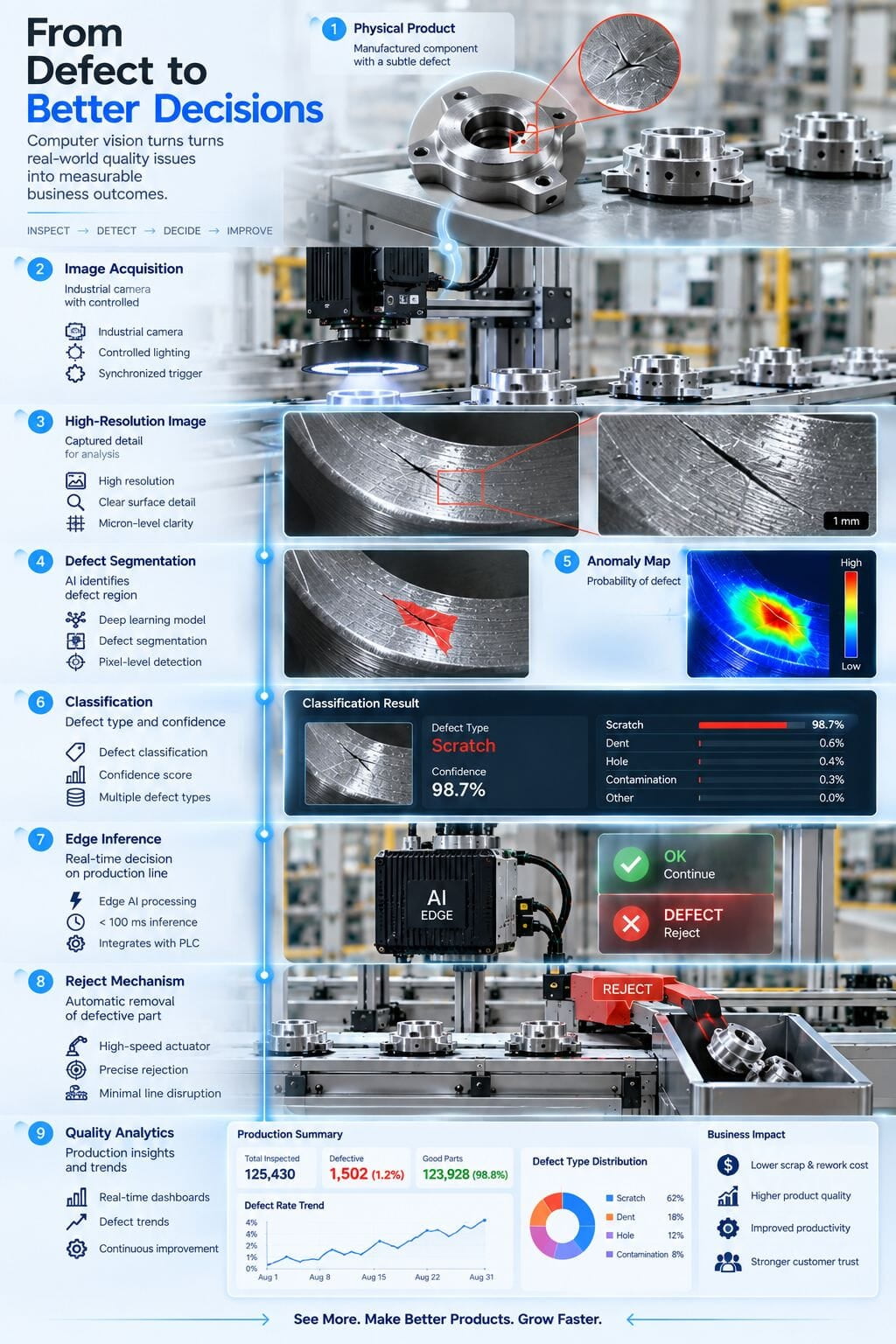
Example: Manufacturing Quality Inspection
BUSINESS PROBLEM
Defective products escaping manual inspection
↓
VISUAL COMPLEXITY
Tiny surface defects + material variation + reflections + production speed
↓
IMAGING STRATEGY
Camera resolution + optics + illumination + viewing geometry
↓
VISION APPROACH
Image enhancement + segmentation + anomaly detection + classification
↓
MODEL STRATEGY
Supervised / anomaly / foundation-model approach depending on available data
↓
DEPLOYMENT
Edge inference + production-line integration + PLC/API connectivity
↓
ACTION
Accept • Reject • Classify • Alert • Trace
↓
BUSINESS IMPACT
Higher Quality • Reduced Manual Inspection • Lower Scrap • Better Traceability
THE REAL PROBLEM — THE LAST 5%
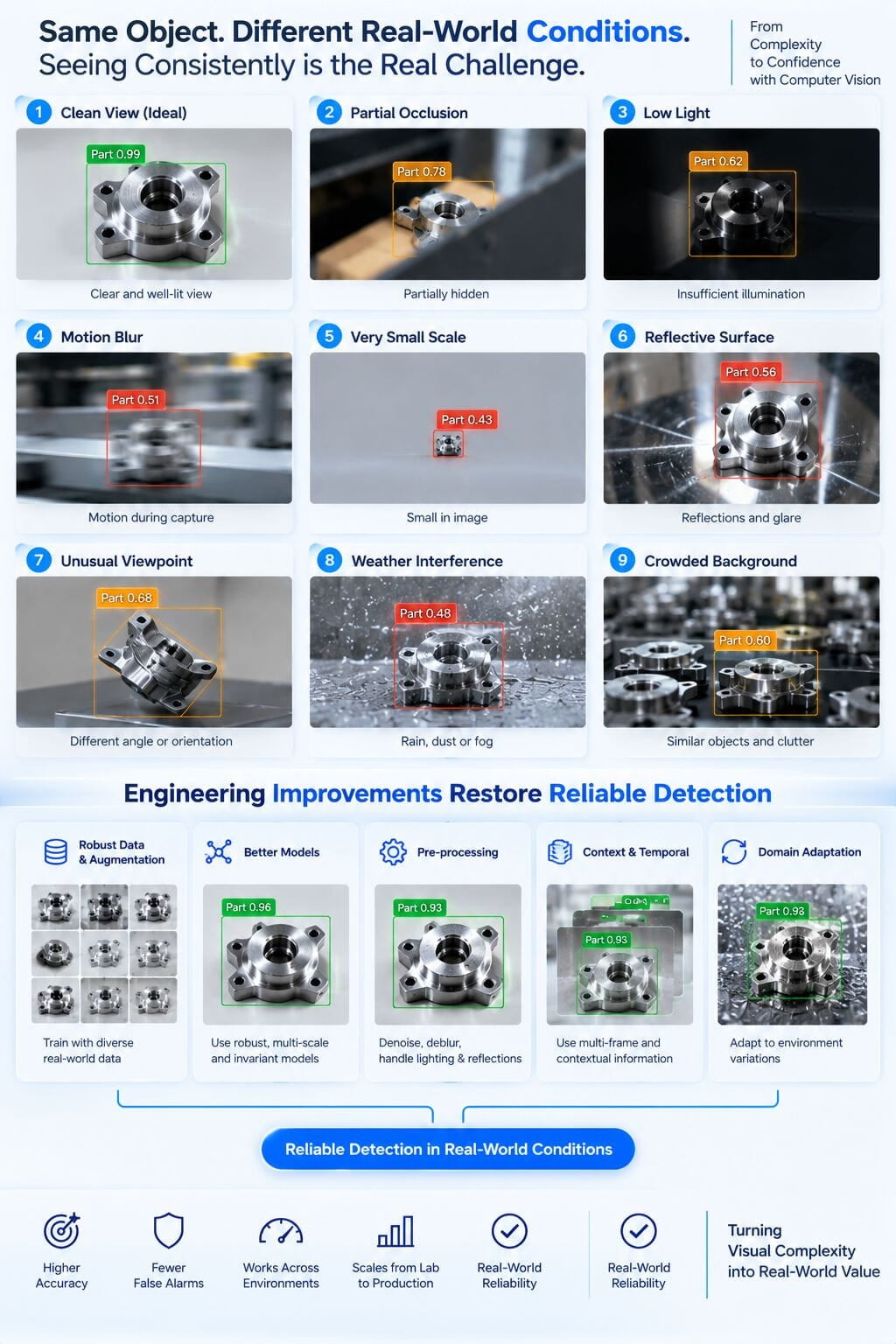
A Model Working 95% of the Time May Still Not Be Production Ready.
Clean examples are usually the easiest part of computer vision.
The difficult problems often live in the remaining cases:
Occlusion
An object is only partially visible.
Low Light
Important features disappear with illumination.
Motion Blur
Movement destroys fine visual information.
Small Objects
Critical objects occupy only a few pixels.
Rare Events
The events that matter most may appear least often in training data.
Reflective Surfaces
Lighting changes apparent surface characteristics.
Unusual Viewpoints
Objects look dramatically different from unseen angles.
Domain Shift
A model trained in one environment encounters another.
Class Imbalance
Common examples dominate while critical rare classes remain underrepresented.
Production computer vision is not only about maximizing accuracy. It is about understanding where the system fails and engineering around those failures.
Your Problem Comes Before the Model.
01 — Understand the Environment
We first study where the system will operate.
Camera position, lighting, distance, movement, object scale, viewing geometry, environmental variation and hardware constraints can determine whether a vision system succeeds or fails.
02 — Define the Visual Problem
What exactly must the machine understand?
Detect something? Separate it? Track it? Measure it? Recognize an activity? Estimate its position? Reconstruct its geometry?
The task definition determines the architecture.
03 — Understand the Data
We examine:
Dataset size • Visual diversity • Annotation quality • Class distribution • Rare cases • Environmental variation • Domain shift • Failure conditions
The question is not simply “How much data do we have?”
It is: "Does the data represent the world in which the system must operate?"
04 — Design the Vision Architecture
Depending on the problem, the solution may combine:
Classical Computer Vision
- Deep Learning
- Vision Transformers
+ 3D Vision - Temporal Models
- Foundation Models
- Multimodal AI
- Rules and Domain Logic
The best architecture is the one appropriate for the problem—not necessarily the newest model.
05 — Validate Beyond Average Accuracy
We evaluate more than a single accuracy number.
Precision • Recall • False Positives • False Negatives • Class-Wise Performance • Rare Cases • Latency • Robustness • Domain Variation
A production system must be understood where it succeeds and where it fails.
06 — Deploy, Monitor & Improve
The model becomes valuable only when integrated into a real workflow.
Edge deployment • Cloud deployment • APIs • Production systems • Robotics • Alerts • Automation • Monitoring • Model updates
Final Methodology Flow
ENVIRONMENT → PROBLEM → DATA → ARCHITECTURE → VALIDATION → DEPLOYMENT → IMPROVEMENT
WHAT MAKES A PRODUCTION VISION SYSTEM?
Accuracy Is Only One Dimension.
🎯 Accuracy
⚡ Latency
🛡️ Robustness
Does the system correctly understand the visual input?
Can it make the decision within the required time?
Does it continue working when conditions change?
📈 Scalability
🔌 Integration
🔄 Adaptability
Can it operate across more cameras, locations and data?
Can the intelligence connect with existing operational systems?
Can the system improve as new conditions and data appear?
A good model solves a dataset. A good vision system solves an operational problem.
HAVE A COMPUTER VISION PROBLEM?
Show Us What Your Cameras See.
You don't need to know which model, architecture or computer vision technique you need.
Start with the problem.
Share a sample image, video, point cloud, sensor stream or description of your visual challenge.
We can help evaluate:
What needs to be detected or understood
What makes the problem technically difficult
Which computer vision capabilities are relevant
What data may be required
Which edge cases need attention
How the solution could be engineered and deployed
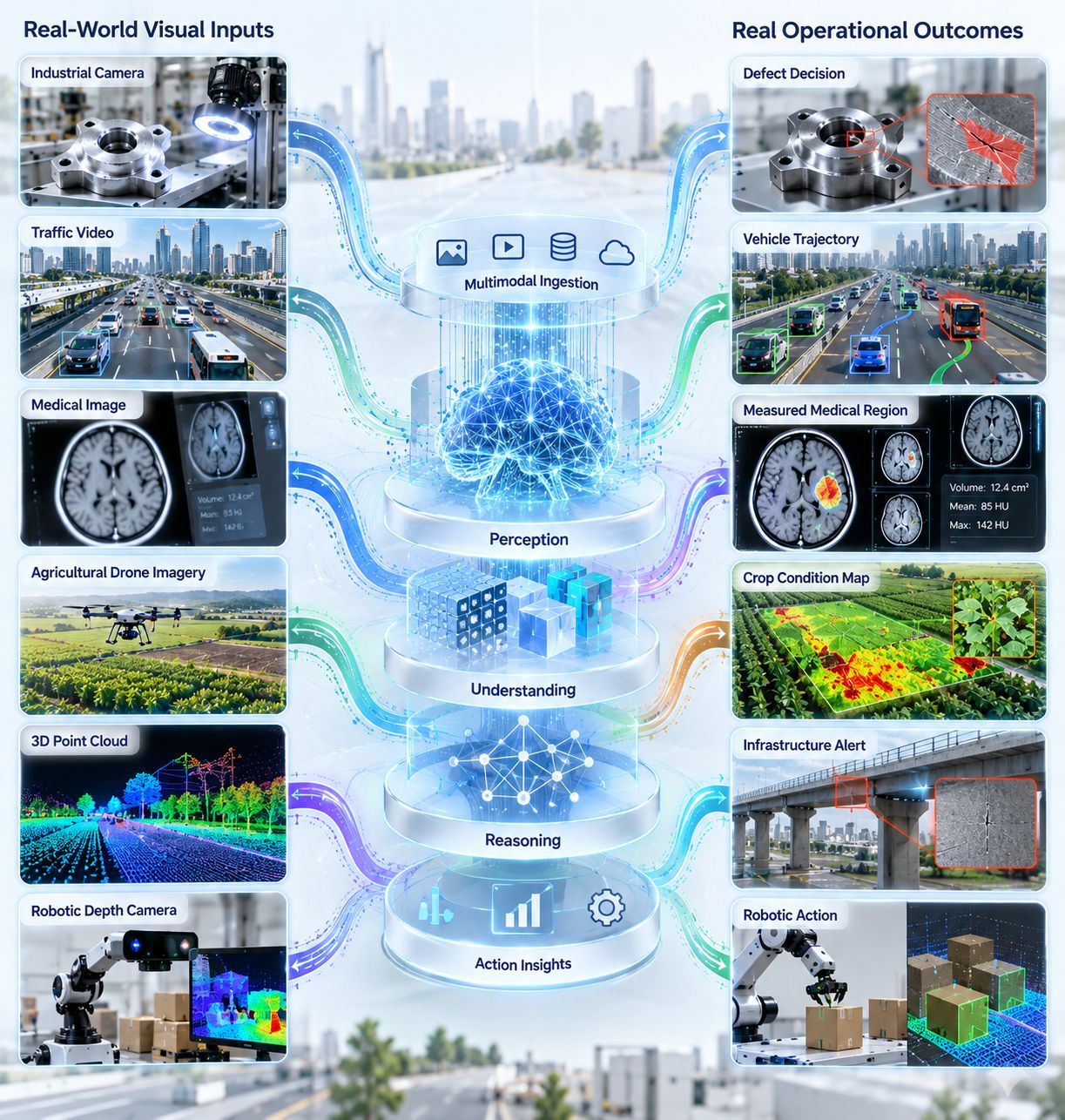
Turn Industry Computer Vision into Real-Time Business Decisions
Tell us your use case, and we’ll map how Industry-Focused Computer Vision can transform your operations—whether it’s inspection, monitoring, automation, or intelligent decision-making tailored to your sector.
What you’ll receive:
- A tailored industry-specific computer vision solution approach
- Relevant use cases aligned to your domain and operational challenges
- Expected impact on efficiency, accuracy, and business outcomes
👉 Get My Industry AI Solution Blueprint
Used across manufacturing, retail, healthcare, transportation, agriculture, infrastructure, security, and robotics for scalable automation, real-time insights, and domain-driven intelligence.