Why Most YOLO Projects Fail in Production: A Practical Framework for Moving from Research to Real-World Deployment
Introduction
YOLO (You Only Look Once) has become the de facto standard for real-time object detection. Every week, organizations across manufacturing, transportation, retail, agriculture, healthcare, security, and robotics launch new proof-of-concepts using YOLO-based systems.
The early results are often impressive.
A model achieves 90%+ accuracy on validation data, detects objects in real time, and performs well during demonstrations. Yet, six months later, many of these same projects struggle to deliver business value.
The reason is simple.
Building a YOLO model is relatively easy.
Building a production-ready vision system is not.
In our experience, most deployment challenges originate not from the neural network itself, but from data quality, camera infrastructure, environmental variability, integration complexity, and operational realities.
This article presents a practical framework that organizations can use before investing heavily in a YOLO deployment.
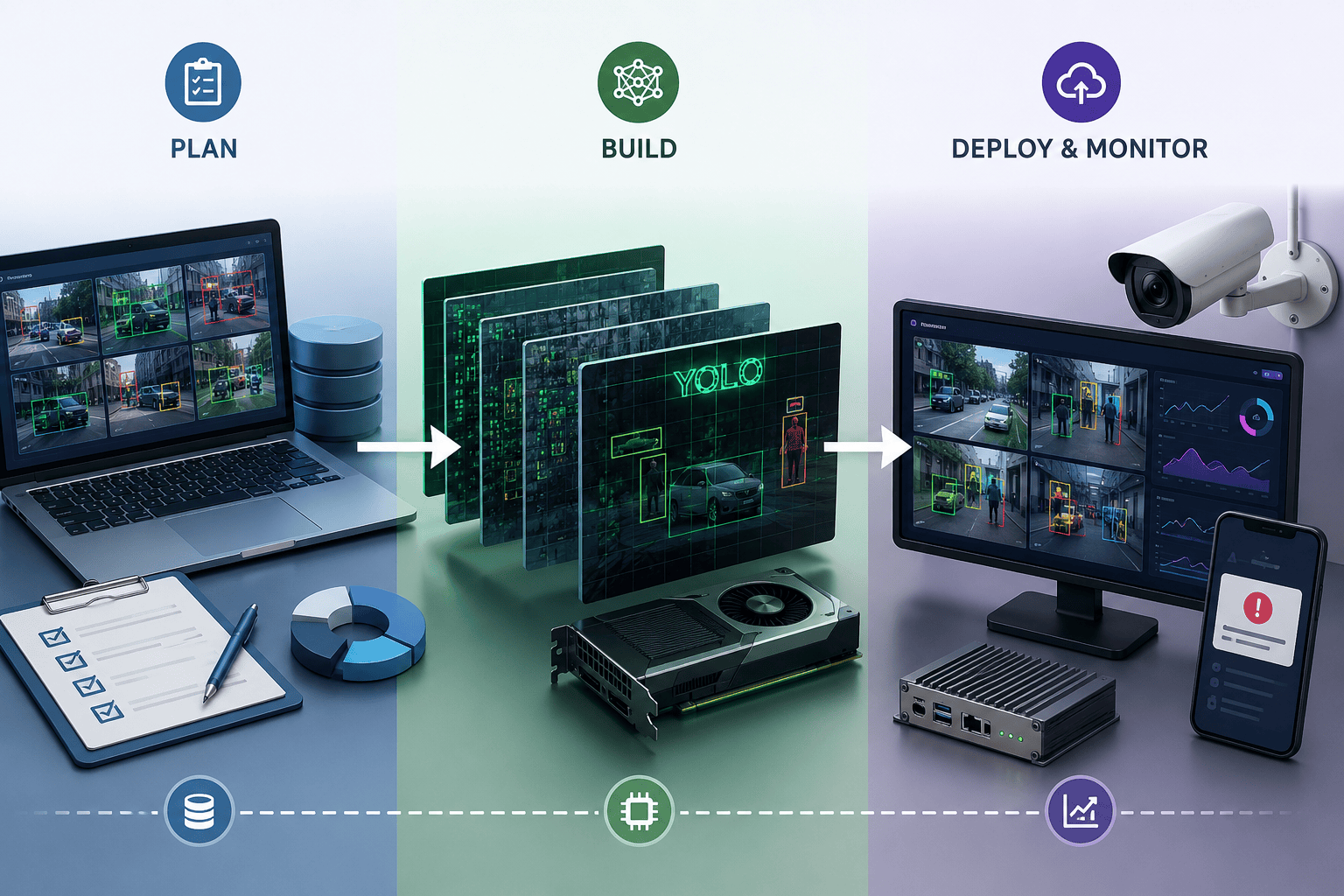
The Production Reality
Academic research focuses on metrics such as:
- mAP
- Precision
- Recall
- F1 Score
- Inference Speed
Production environments care about something very different:
- Reduced inspection cost
- Faster incident response
- Improved safety
- Reduced inventory loss
- Increased throughput
- Better operational decisions
A model can achieve excellent benchmark performance while still failing to solve the underlying business problem.
The first step toward success is understanding this distinction.
Section 1: Before You Start — The YOLO Production Readiness Checklist
Before training a single model, organizations should evaluate whether they are truly ready for deployment.
1. Business Objective Validation
The most important question is not:
"Can YOLO detect this object?"
The more important question is:
"What business action will occur when the object is detected?"
Consider:
✓ What decision will be automated?
✓ What workflow will change?
✓ What is the cost of a missed detection?
✓ What is the cost of a false alarm?
✓ How will ROI be measured?
Without clear answers, even technically successful projects often fail.
2. Dataset Readiness
Most production failures can be traced back to data.
A deployment dataset should include:
✓ Day and night conditions
✓ Seasonal changes
✓ Different weather conditions
✓ Multiple camera viewpoints
✓ Various object sizes
✓ Occlusions and crowding
✓ Rare but critical events
A model can only learn what it has seen.
If your deployment environment is not represented in the dataset, performance degradation should be expected.
3. Annotation Quality Assessment
Many teams underestimate the impact of annotation quality.
Common issues include:
- Missing labels
- Inconsistent bounding boxes
- Ambiguous object definitions
- Different annotation styles
The quality of annotations often places a hard limit on achievable performance.
No architecture can compensate for poor labels.
4. Camera Infrastructure Review
Many "AI problems" are actually camera problems.
Evaluate:
✓ Resolution
✓ Camera placement
✓ Mounting height
✓ Lens type
✓ Lighting conditions
✓ Field of view
✓ Maintenance process
A poorly positioned camera can reduce performance more than switching between detector architectures.
5. Deployment Hardware Assessment
A model that performs well on a development workstation may behave very differently on production hardware.
Validate:
✓ Edge vs cloud deployment
✓ Available GPU resources
✓ Memory requirements
✓ Power limitations
✓ Network constraints
✓ Thermal conditions
Production success depends on the entire infrastructure stack, not just the model.
Section 2: How to Build a Production-Grade YOLO System
Once readiness has been established, the focus shifts toward engineering reliability.
Adopt a Data-Centric Development Strategy
Modern AI development has shifted from model-centric thinking toward data-centric thinking.
The most effective workflow is:
Data Collection
↓
Model Training
↓
Failure Analysis
↓
Additional Data Collection
↓
Retraining
↓
Deployment
This cycle continues throughout the system lifecycle.
In practice, improving the dataset often delivers greater gains than changing architectures.
Validate Across Real Operating Conditions
Many deployments are tested only under ideal conditions.
Production systems should be evaluated under:
Environmental Variability
- Rain
- Fog
- Dust
- Shadows
- Reflections
- Low-light conditions
Scene Variability
- Crowded environments
- Partial occlusions
- Motion blur
- Camera vibrations
Testing under realistic conditions dramatically reduces deployment surprises.
Optimize for the Target Hardware
Production systems frequently operate on:
- NVIDIA Jetson devices
- Industrial PCs
- Embedded platforms
- Edge servers
Optimization techniques may include:
- TensorRT acceleration
- Quantization
- Mixed precision inference
- Model pruning
- Pipeline optimization
The objective is not maximum accuracy.
The objective is optimal operational performance.
Design the Entire Vision Pipeline
YOLO should not be viewed as the final solution.
It is one component within a larger system.
A typical production architecture looks like:
Camera
↓
YOLO Detection
↓
Object Tracking
↓
Event Generation
↓
Business Rules
↓
Dashboard & Reporting
↓
Enterprise Systems
The value comes from operational decisions, not detections alone.
Implement Continuous Monitoring
Production AI systems evolve.
New products appear.
Lighting changes.
Camera positions shift.
Operational processes evolve.
Without monitoring, performance inevitably degrades.
Monitor:
✓ Precision
✓ Recall
✓ Latency
✓ Hardware utilization
✓ Camera health
✓ Alert quality
The most successful deployments treat AI as a continuously improving capability rather than a one-time project.
Section 3: How We Help Organizations Deploy YOLO Successfully
At Visual Grab, we view computer vision deployment as a systems-engineering challenge rather than a model-training exercise.
Our approach spans the complete lifecycle.
Research & Feasibility Assessment
Before development begins, we evaluate:
- Business objectives
- Technical feasibility
- Deployment risks
- ROI potential
- Data requirements
The goal is to determine whether a vision-based solution is practical and economically viable.
Dataset Engineering
We help organizations:
- Design data collection strategies
- Create annotation standards
- Audit dataset quality
- Build representative datasets
- Address edge-case scenarios
A strong dataset is the foundation of a reliable production system.
Model Development & Benchmarking
Our team develops and evaluates:
- YOLO-based detectors
- Segmentation pipelines
- Tracking systems
- Multi-camera solutions
- Edge-optimized architectures
Performance is measured against operational objectives, not just benchmark metrics.
Edge Deployment & Optimization
We support deployment across:
- NVIDIA Jetson platforms
- Industrial edge devices
- GPU servers
- Hybrid cloud architectures
Optimization ensures the system performs reliably under production constraints.
Enterprise Integration
A vision model creates value only when connected to business processes.
We integrate computer vision solutions with:
- ERP systems
- MES platforms
- SCADA environments
- Workflow engines
- Operational dashboards
This transforms detections into actionable intelligence.
MLOps and Continuous Improvement
After deployment, we support:
- Model monitoring
- Drift detection
- Retraining pipelines
- Performance audits
- Long-term optimization
This ensures sustained value over the lifetime of the system.
Looking Ahead
The future of computer vision is moving beyond object detection.
Emerging technologies include:
- Vision-Language Models (VLMs)
- Multimodal AI Systems
- Agentic AI Frameworks
- Foundation Vision Models
- Edge Generative AI
- Autonomous Decision Systems
Future production systems will not simply detect objects.
They will understand context, reason about situations, and automate complex decisions.
Organizations that establish strong vision infrastructures today will be best positioned to take advantage of these advances.
Conclusion
The biggest misconception in computer vision is that deploying YOLO is primarily a machine learning challenge.
It is not.
Successful deployments depend on data engineering, camera design, infrastructure planning, workflow integration, operational monitoring, and continuous improvement.
Organizations that focus exclusively on model accuracy often struggle in production.
Organizations that adopt a systems-engineering approach consistently achieve better outcomes.
The journey from research to production is not about deploying a detector.
It is about building a reliable visual intelligence system that creates measurable business impact.
Before asking whether YOLO can solve your problem, ask whether your organization is ready to deploy it successfully.